
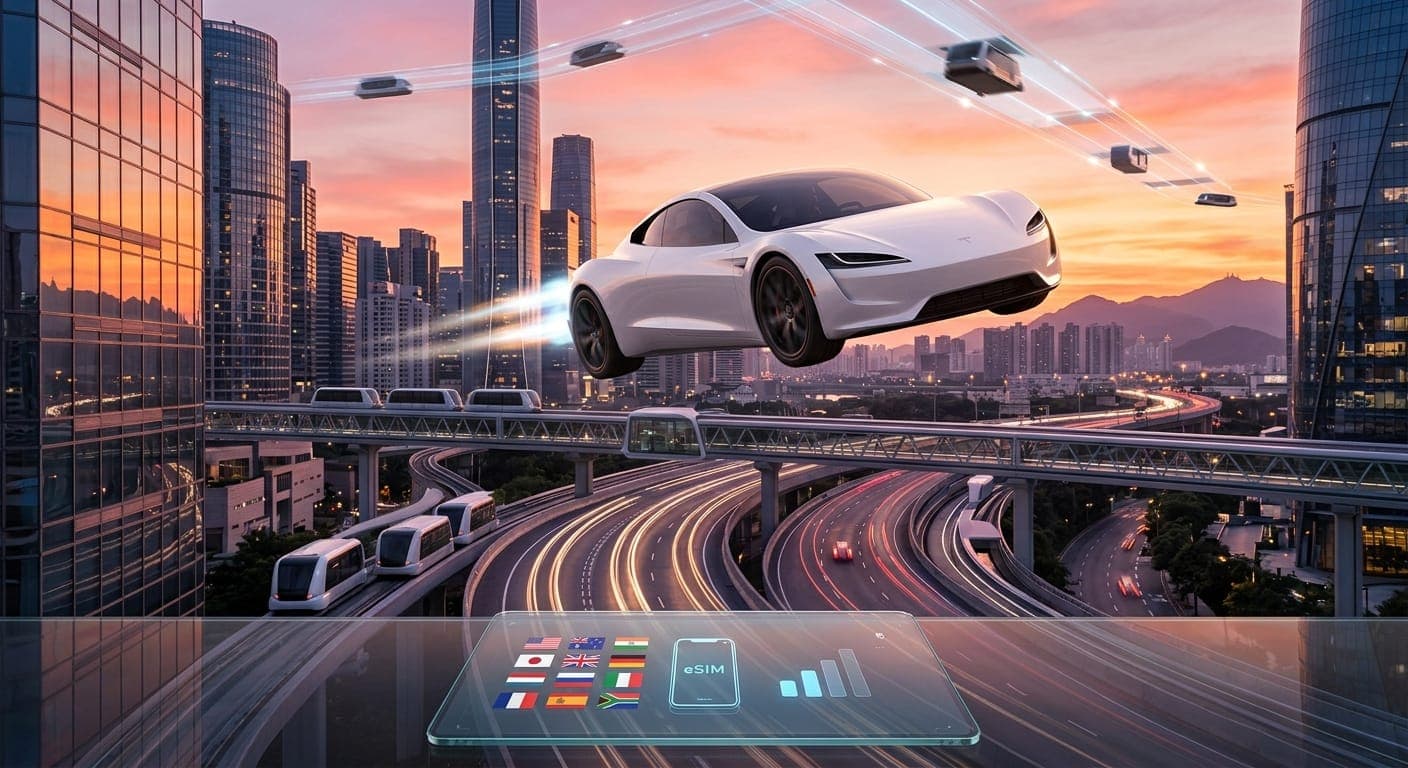
For decades, flying cars belonged to science fiction, from Blade Runner to The Jetsons. Tesla's latest Roadster demonstration has put the idea back in the headlines.
This article looks at what was actually shown, how far it is from a certified flying car, and what it says about where travel is heading. Flying cars are years away, but one part of future travel is already here: your phone needs mobile data from the moment you land, wherever you are.
The Tesla Flying Car Revelation: What Was Demonstrated?
Elon Musk showcased the long-awaited next-generation Tesla Roadster equipped with a specialized SpaceX package.
SpaceX Thrusters and Short Airborne Maneuvers
During a public demonstration on October 15, Tesla unveiled a working prototype of the next-gen Roadster fitted with high-pressure, cold-gas thrusters developed in collaboration with SpaceX. Rather than acting as a traditional airplane or helicopter, the system utilizes compressed air thrusters concealed behind the license plate and body panels to perform rapid acceleration and short airborne maneuvers.
Key technical highlights from the demonstration included:
Cold-Gas Thrusters: Utilizing ultra-high-pressure air tanks similar to those used on SpaceX Falcon rockets to provide instant vertical lift and rapid directional thrust.
Hovers and Airborne Shifts: The vehicle demonstrated short, controlled hovers and low-altitude jumps over obstacles, proving that atmospheric thruster propulsion can be integrated into a road-legal chassis.
2028 Production Target: Tesla reported an ambitious production target for 2028, pending regulatory frameworks for thruster-assisted personal vehicles.
Demonstration vs. Fully Certified Flying Cars
The October 15 demonstration was an engineering milestone, but there is a big difference between a thruster-assisted prototype and a fully certified, practical flying car.
Regulatory Approval: Civil aviation authorities (such as the FAA and EASA) enforce stringent certification processes for airworthiness, airspace management, and passenger safety.
Noise and Energy Demands: High-pressure gas propulsion generates significant noise levels and requires substantial energy reserves, limiting hovering times compared to standard highway driving.
Infrastructure Needs: Sky-traffic routes, automated air traffic control systems, and designated vertical take-off areas must be developed before airborne personal travel becomes a reality.
While mass-market flying cars remain years away from widespread adoption, the shift toward hyper-connected, autonomous transport is happening right now.
How Travel Is Becoming Fully Connected
Flying cars may take years to arrive, but travel has already gone digital. Most of what you do on an international trip now runs through your phone:
Real-time navigation and transit updates
Digital boarding passes
Hotel check-ins and keyless room access
Ride-hailing apps (Uber, Grab, Bolt)
Voice and camera translation
Contactless mobile payments and digital banking
Safety alerts and local emergency bulletins
Remote work and cloud productivity tools
AI travel assistants and itinerary apps
When you land in a foreign city, your phone becomes your map, wallet, translator and guidebook. Without data, even the airport transfer gets harder.
The Problem with Traditional International Data Solutions
Plenty of travelers still rely on older ways of getting online abroad, and both have drawbacks.
1. Traditional International Roaming
Relying on your home mobile carrier’s international roaming package often leads to severe drawbacks:
Exorbitant Costs: International daily passes or per-megabyte rates can result in unexpected bill shocks upon returning home.
Throttled Speeds: Carriers often route international traffic through home-country servers, leading to high latency and reduced 3G/4G speeds.
2. Physical SIM Cards
Purchasing a local SIM card at your destination presents a different set of challenges:
Airport Kiosk Queues: Waiting in long lines after an exhausting long-haul flight.
Language Barriers & Registration: Navigating registration forms in foreign languages and providing passport copies.
Risk of Loss: Removing your primary physical SIM card increases the risk of misplacing or damaging your tiny SIM chip.
What Is a Travel eSIM and How Does It Work?
An eSIM (Embedded Subscriber Identity Module) is a programmable, industry-standard digital SIM built directly into your smartphone, tablet, or smartwatch during manufacturing.
Choose and buy a data plan for your destination online.
Scan the QR code to install the eSIM profile on your phone.
Switch it on when you land and connect to a local partner network.
Instead of physically swapping plastic cards, a travel eSIM allows you to download cellular profiles over the air. You can store multiple profiles on a single device and switch between data plans in seconds while keeping your primary phone number active for calls and two-factor authentication (2FA) SMS codes.
Connectivity Comparison: Modern Travel Options
Here is how the main options compare in common travel situations:
Travel Scenario | Connectivity Need | Traditional Roaming | Physical SIM | Travel eSIM |
|---|---|---|---|---|
Landing at Destination Airport | Instant map access, ride-hailing app, family status update | Expensive auto-roaming or no data until configured | Must locate a terminal store, queue, and swap physical cards | Instant connection as soon as airplane mode is turned off |
Multi-Country Trips (e.g., Europe/Asia) | Continuous coverage across border crossings | Re-activates daily roaming fees per country | Requires purchasing new local SIM cards in each nation | A single regional plan keeps working across borders |
Keeping Primary Number Active | Receiving 2FA bank codes and emergency calls | Active, but incurs high data fees if roaming is toggled on | Primary SIM must be physically removed from phone slot | Secondary data line active; primary SIM stays safe in tray for calls/SMS |
On-the-Go Top-Ups | Extra data for streaming or video conferencing | Costly tier upgrades managed through home carrier | Requires finding a local retail store or navigating foreign top-up apps | Digital top-up via app or website instantly applied to device |
The Connectivity Requirements of Future Travel
As autonomous transport and artificial intelligence reshape global mobility, data demands will expand far beyond personal browsing.
1. Autonomous Mobility & Real-Time Telemetry
Vehicles equipped with autopilot and short-burst hovering features generate massive amounts of environmental data. High-speed, low-latency cross-border data guarantees that navigation algorithms receive real-time updates regarding terrain, weather shifts, and localized airspace restrictions.
2. In-Vehicle Infotainment and Productivity
As vehicles assume more control over navigation, passengers will use travel time for high-bandwidth activities: HD video conferencing, cloud collaboration, and streaming entertainment.
3. AI-Powered Travel Assistants
AI travel agents are starting to manage itineraries on the fly: rebooking flights during delays, adjusting hotel reservations, and updating transit connections in real time. These agents rely on persistent background data to work effectively.
What Travelers Can Do Today: Use a Travel eSIM
You don't need to wait for flying cars to travel smarter. Switching to a travel eSIM is something you can do before your next trip.
CloudOn sells travel eSIMs you can buy and install from your phone before you leave:
Install before departure: pick your destination plan online, install the eSIM with a QR code, and switch it on when you land. Our step-by-step installation guide covers iPhone and Android.
Keep your number: your main SIM stays active for calls and verification texts while the eSIM handles data.
Choose your coverage: single-country plans, regional plans such as Europe and Asia, or a global eSIM for multi-region trips.
Useful CloudOn Links
Browse plans by country: all destinations
Check that your phone supports eSIM: eSIM compatibility
How eSIM works: how CloudOn works
Questions or setup help: help center
Refunds: refund policy
Frequently Asked Questions (FAQ)
What devices support travel eSIMs?
Most modern smartphones released in recent years support eSIM technology, including iPhone XS and newer models, Google Pixel 3 and newer, as well as recent Samsung Galaxy flagship devices. Always verify your device's unlocked status and specific regional hardware configuration before purchasing.
Can I keep my WhatsApp and original phone number while using an eSIM?
Yes. Installing an eSIM for international data does not affect your WhatsApp account or primary phone number. You keep using your regular account over the eSIM's mobile data. See WhatsApp with a data-only eSIM for details.
When should I install my travel eSIM?
It is best to install your travel eSIM prior to departure while connected to a stable Wi-Fi connection at home or in the airport. You can keep the line toggled off until you arrive at your foreign destination, then switch it on to instantly access local data networks.
Is the Tesla flying car real and available for purchase?
Tesla demonstrated a prototype Roadster with SpaceX cold-gas thruster integration during an event on October 15, showing short airborne hover capabilities. Tesla reported a target production goal of 2028, though consumer availability remains contingent upon regulatory and safety approvals.
Interested in where aviation is heading too? Read AI in the cockpit: will planes fly themselves?
Ready to get an eSIM?
Browse plans for 190+ countries. Purchase in minutes, install in seconds.